
✓
3 h 23 min
Total sample-to-screen turnaround in the deck, compared with 38 h 46 min for cell-block IHC.
Documented MVZ Frankfurt time-motion study comparing routine pleural-effusion samples processed by cell-block IHC and X-ZELL NGC workflows.
Figures below are framed as workflow performance, not as a stand-alone diagnostic-accuracy trial.
Total sample-to-screen turnaround in the deck, compared with 38 h 46 min for cell-block IHC.
The consolidated workflow moves from multiple MTAs and stations to one MTA at one workstation.
The NGC path reduces process steps while adding eight-channel multiplex information on one slide.
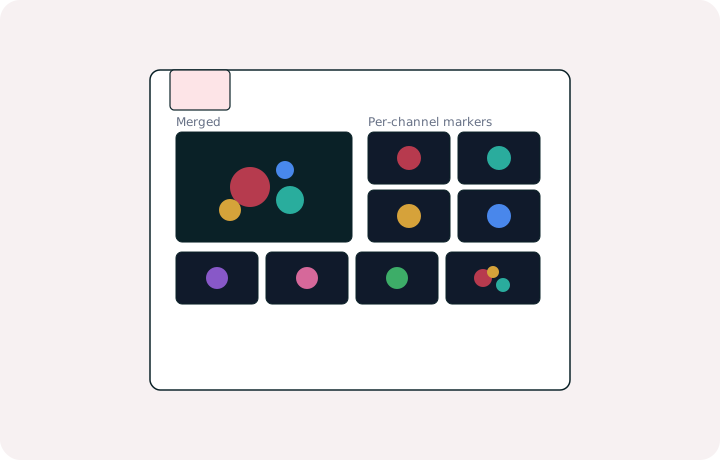
A single NGC slide can yield up to eight marker data points from limited cytology material.
Cryofixator™ and Cryostainer™ are listed at 18 kg each, versus a 295 kg comparator system.
Workflow consolidation reduces handoffs between separate stations and manual sample movement.
Compares a Roche Ventana Benchmark-class cell-block + automated IHC workflow with the X-ZELL NGC architecture.
Cell-blocking required. One antibody per slide. Approximately 38 h 46 min sample-to-screen turnaround. Multiple technicians, multiple stations, and repeated sample movement.
No cell-blocking. Up to eight antibodies per slide. Under-four-hour sample-to-screen workflow. One MTA, one workstation, and direct digital channel review.
Source: MVZ / Institute of Pathology Main-Taunus, Frankfurt (2022-2023), as summarized in the master deck. The study is described as a single-site time-motion study with a before/after design and two documented routine runs of 27 pleural-effusion samples processed in both workflows.
The figures should be presented as workflow and handling measures unless the accompanying clinical-validation evidence is also reviewed.
The validation page summarizes the 2026 clinical-validation section of the deck, including antibody-level concordance.
Evidence note: Clinical performance must be established in the intended patient-specimen context. Product availability, regulatory status, and intended use may vary by market. Please contact X-ZELL for current documentation.